Modernizing Accounts Receivable
Cash flow is the lifeblood of every business.
Whether an organization manages commercial invoices, patient balances, consumer payments, loan repayments, membership dues, utility bills, or professional service fees, the challenge remains the same:
Getting paid efficiently while delivering a positive customer experience.
Yet Accounts Receivable remains one of the most fragmented and manually intensive areas of many organizations.
The latest data demonstrates the scale of the opportunity:
- In the United States,43% of credit-based B2B sales were overdue in 2025, with customer cash-flow pressures cited as a primary cause.
- In a 2025 survey of 104 senior North American finance leaders, only3% reported having fully automated their AR operations. Manual workflows remained the leading challenge across invoicing, collections, payments, and reporting.
- The same research found that47% of organizations had limited or no visibility into key AR metrics, including DSO, aging, collection effectiveness, and cash-flow forecasting.
- On the consumer side,58% of healthcare consumers said they would switch providers for a better payment experience, showing that billing and payment processes can influence customer loyalty—not simply collections performance.
These statistics reinforce something I have observed throughout my career:
The biggest challenge is not always collecting the payment.
It is managing the process that leads to getting paid.
Every Outstanding Balance Has a Story
An outstanding balance does not automatically mean a customer is unwilling to pay.
A commercial invoice may have been overlooked.
A patient may be waiting for an insurance adjustment.
A borrower may need a different payment arrangement.
A customer may have a billing question that has not been answered.
Another customer may respond to a text message but never see an email.
The underlying issue may be timing, communication, affordability, confusion, or convenience.
However, many businesses still approach every outstanding balance in largely the same way: send a reminder, wait, follow up manually, and escalate when the balance becomes significantly overdue.
That process creates challenges in bothB2B and B2Cenvironments.
Finance and billing teams may be managing hundreds—or thousands—of accounts across disconnected systems:
- Invoices or statements are generated in one application.
- Emails are sent from another.
- Phone calls are tracked separately.
- Payments are processed through a different platform.
- Customer questions are handled through individual inboxes.
- Reports are manually assembled from multiple sources.
Every handoff creates another opportunity for delay.
Every disconnected system limits visibility.
Every missed follow-up increases the likelihood that an account will continue aging.
Modernizing the Entire Receivables Journey
Modernizing Accounts Receivable does not simply mean replacing spreadsheets with another piece of software.
It means connecting the complete receivables journey—from the first invoice or statement through communication, payment resolution, early-stage recovery, and, when necessary, escalation.
That is why we builtAgile Receivables.
Agile helps organizations manage B2B, B2C, or hybrid receivables through one centralized platform.
Businesses can use Agile to:
- Automate payment reminders and follow-up campaigns.
- Communicate through email, SMS, AI-powered voice, ringless voicemail, and traditional mail.
- Build different engagement workflows based on account type, balance, aging, customer segment, or business rules.
- Provide secure options for full, partial, installment, or scheduled payments.
- Allow customers to raise billing questions before they become unresolved disputes.
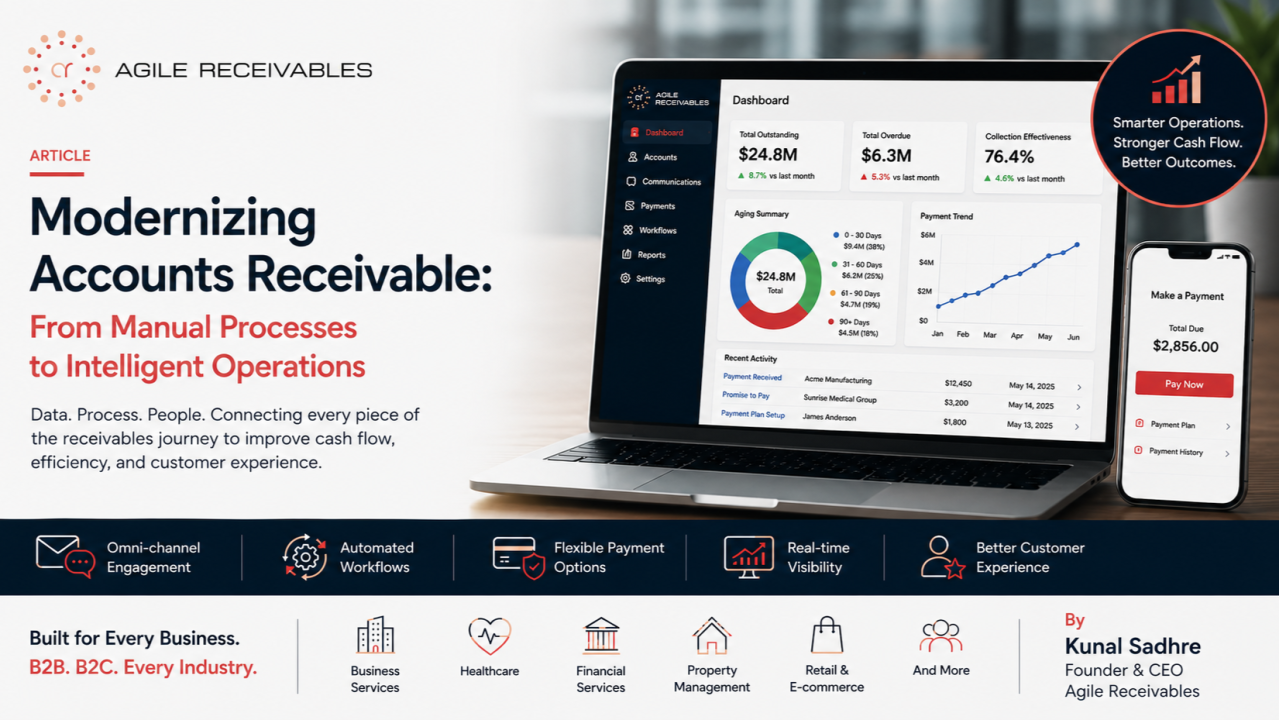
- Monitor communication, account activity, and payment performance through a centralized dashboard.
- Use existing payment gateways and operational systems instead of replacing the entire technology environment.
- Escalate accounts to third-party or legal collection partners when appropriate.
The purpose is not to send more messages.
It is to create a more structured, timely, and effective receivables process.
Bringing Intelligence Into Daily Operations
Automation is valuable because it eliminates repetitive work.
Intelligence makes that automation more effective.
Agile combines configurable business rules with intelligent capabilities that help organizations create campaigns, personalize communications, prioritize accounts, and determine the appropriate next action.
For example, an organization may need different strategies for:
- A new invoice that has not yet reached its due date.
- A patient balance awaiting insurance resolution.
- A consumer who has engaged but needs payment flexibility.
- A commercial customer with multiple open invoices.
- An account that has not responded through email but may respond through SMS or voice.
- A customer who has raised a dispute and should temporarily stop receiving payment reminders.
These situations should not all receive the same message, through the same channel, at the same time.
Agile helps organizations apply more structured and personalized workflows while maintaining human oversight.
Technology should not replace the judgment of finance, billing, or customer-service professionals.
It should give them better information, eliminate unnecessary administrative work, and allow them to focus on the situations that genuinely require human involvement.
Visibility Is Just as Important as Communication
Effective receivables management is not only about contacting customers.
It is also about understanding what is happening across the portfolio.
Which accounts are engaging?
Which communication channels are performing best?
Where are customers encountering payment friction?
Which balances require immediate attention?
How many accounts have raised billing questions?
Where are workflows slowing down?
Without centralized visibility, teams are forced to make decisions using incomplete information.
That is why modern AR operations need more than reminder automation. They need connected communication, payment activity, workflow management, and reporting.
The goal is to help organizations move from simply reviewing what happened to understanding what should happen next.
The Business Impact
Modernizing Accounts Receivable is not simply a finance initiative.
It is a business initiative.
A more connected receivables operation can help an organization:
- Improve cash flow and accelerate payment resolution.
- Reduce manual administrative effort.
- Create more consistent B2B and B2C communication.
- Improve visibility across the receivables lifecycle.
- Provide customers with more convenient ways to engage and pay.
- Strengthen collaboration among finance, billing, operations, and customer-service teams.
- Reduce the number of accounts reaching later-stage collections.
- Scale account volumes without proportionally increasing staffing requirements.
The benefits extend beyond the AR department.
Better communication can improve the customer experience.
Better visibility supports stronger decision-making.
More efficient operations free employees to focus on higher-value work.
And improved cash flow gives businesses greater flexibility to invest, innovate, and grow.
Looking Ahead
Businesses have transformed sales, marketing, customer service, and operations through technology.
Accounts Receivable deserves the same level of attention.
At Agile Receivables, we believe the future of AR is not about chasing customers more aggressively.
It is about building a connected and intelligent operation that helps businesses engage earlier, communicate more effectively, simplify payment resolution, and make better decisions throughout the receivable's lifecycle.
Because modernizing Accounts Receivable is not just about collecting what is owed.
It is about creating a stronger, more efficient business.
How is your organization modernizing its Accounts Receivable process—and what remains the biggest obstacle?